
Beth Waterbury
Photos by Beth Waterbury unless otherwise noted
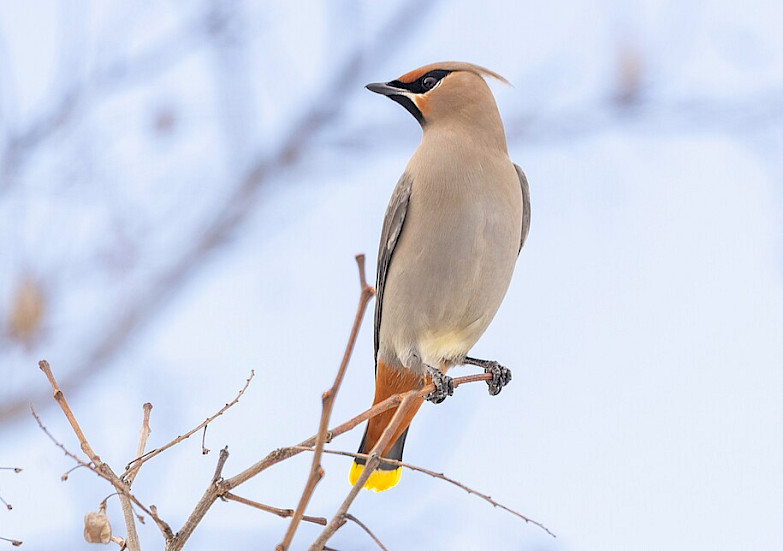
No, not that Bohemian rhapsody. This rhapsody is about “an ecstatic expression of feeling” one has when thousands of Bohemian Waxwings spend the winter in your backyard. Never in my 25 years in the Intermountain West have I spent as much time in their company, and never have I observed such huge numbers as this past winter. Since Bohemians are irregular and uncommon winter visitors to the lower 48, I thought I would share some of my observations and images from this amazing visitation.
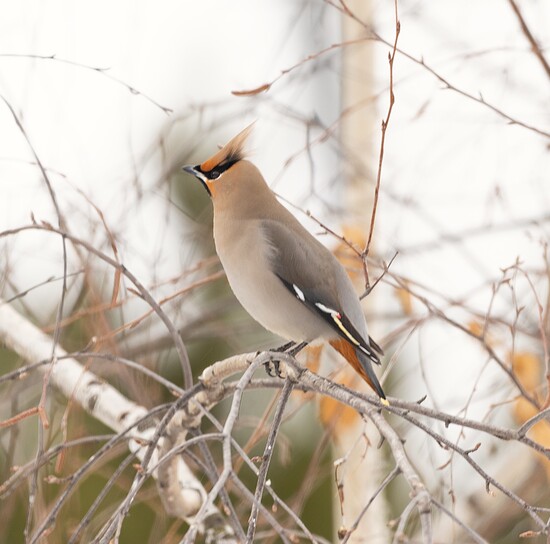
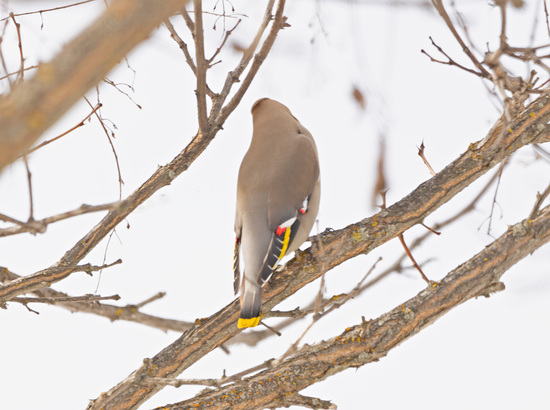
First, a brief overview of this striking bird with the intriguing name. The Bohemian Waxwing is a plump-bellied bird with a shaggy crest atop a small head, has a fairly short, square-tipped tail, is 6.5-7.5” in length, and has a 13” wingspan. Their color pattern is grayish brown overall with a delicate peach wash around a black mask and chin, and a rufous undertail. Its yellow-tipped tail, wings with rectangular white patches, and blood-red wax-like tips on the secondaries add splashes of vivid color to this handsome bird.
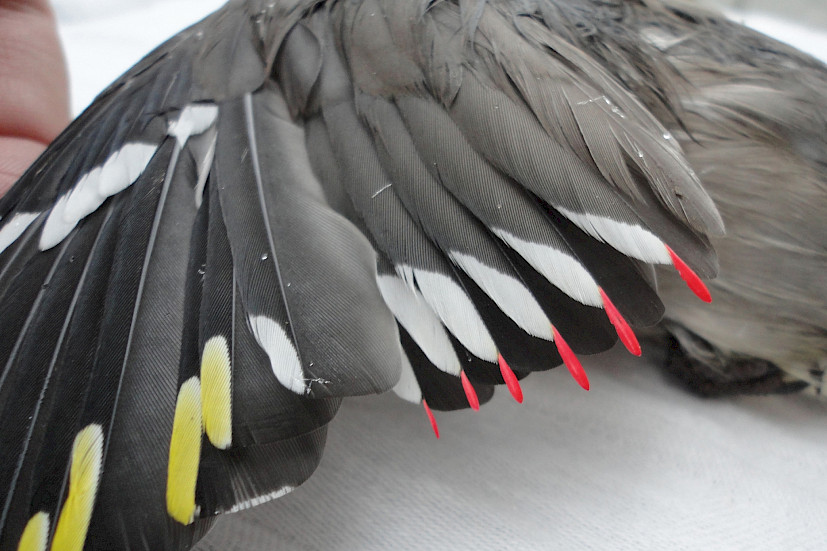
Outstretched wing of a Bohemian Waxwing showing modified red “waxy” tips of feather shafts.
attribution: Amphis, public domain
The Bohemian Waxwing’s scientific name describes the silky appearance of their feathers (Bombycilla) and its “talkative, chattering” nature (garrulus). The “waxwing” common name refers to the bright red tips of the secondary feathers that look like drops of sealing wax. Rather, these are the extended, flattened tips of feather shafts colored by carotenoid pigment and encased in a transparent sheath. “Bohemian” alludes to the bird’s wandering, nomadic behavior traditionally practiced by the Romani/Gypsy people.
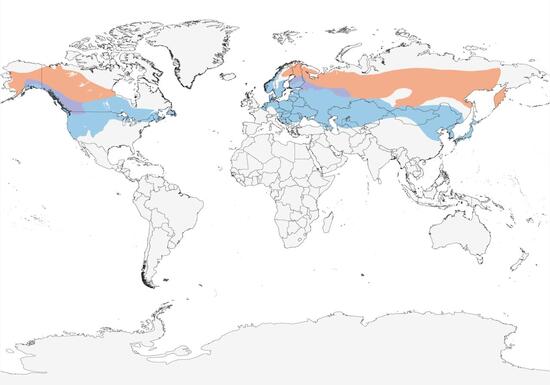
Bohemian Waxwing range map
(attribution: Lynx Edicions/Bird Life International)
The range of Bohemian Waxwings is circumpolar. They breed in northern forests of North America and Eurasia (60-67° latitude) and winter southward in flocks in search of fruit. They are known for making unpredictable and irruptive movements beyond normal winter range in their quest for food. In winter, Bohemians forage on dried fruits, stripping shrubs and trees of fruit then moving on. Winter staples are mountain ash berries, apples, crabapples, juniper berries, cotoneaster berries, rose hips, and highbush cranberries. A specialized large liver allows waxwings to convert sugar-rich dried fruits to energy, but frequent drinks of water are needed to stave off dehydration.
The Bohemians showed up November 29th on a cold, gray wintery day. I was looking east from the dining room window at a sweeping view of the creek to look for a Bald Eagle or a duck. Above the horizon I saw a shape-shifting swarm of birds — a murmuration — lifting and falling into the junipers, cottonwoods, and pines along the creek.
“BOHEMIANS!” I yelled to my husband. “HUNDREDS OF THEM!”
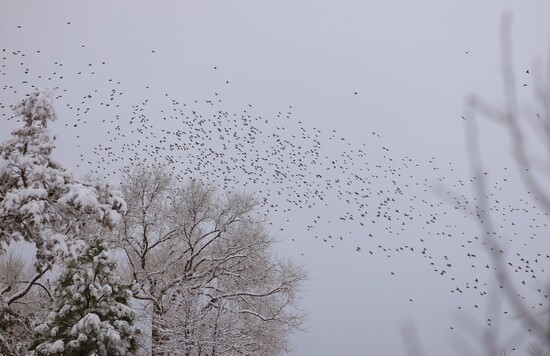
We watched the restless flock dive en masse into Western Junipers, then explode out to fly in wide arcs, eventually suctioning into the upper canopies of cottonwoods.
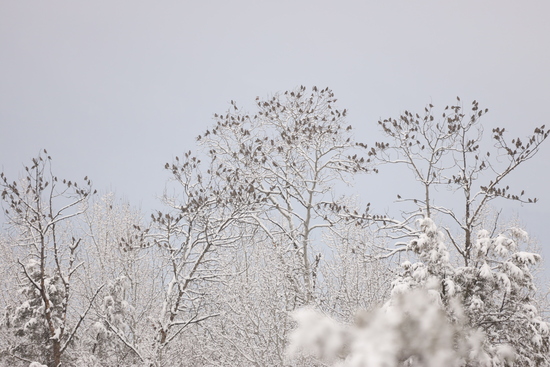
“MORE LIKE THOUSANDS,” he countered. “LET’S GET CLOSER!”
We hiked to a vantage point from the creek bottom and waited. We heard them first: a wall of high-pitched, raspy trilling. We located a portion of the flock flying between junipers and cottonwoods. Then the entire flock took to the air…….
Okay, how was I going to report this observation on eBird? My brain could not come up with a realistic number to even estimate! So, I did some computer screen calculations from a couple of still shots (# of birds/linear few inches of screen x screen width) and came up with a conservative estimate of ~5,000 Bohemian Waxwings. To my surprise, eBird didn’t flag my checklist.
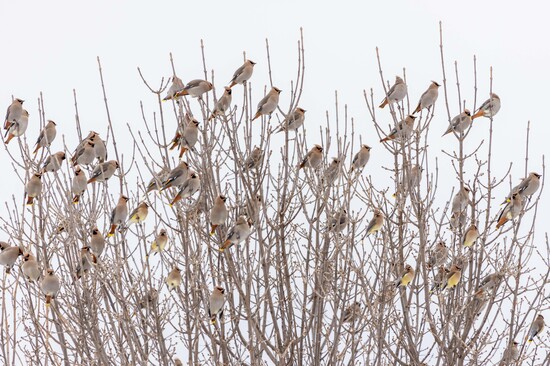
Over the next 3.5 months, Bohemian Waxwings meandered in and out of the property. We’d often see a flock of ~100-200 perched atop the tall cottonwoods across the creek, making short forays to feed on Western Juniper berries or catch and drink snowflakes on the wing.
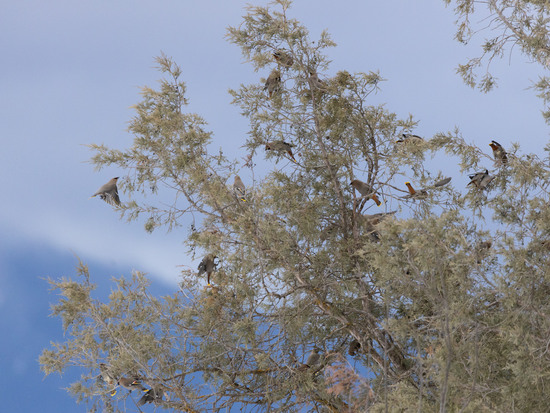
On occasion, Bohemians would venture into the yard, usually on mild days when there were snowmelt puddles or small hatches of flying insects.
Other fruit-eating birds, including Townsend’s Solitaires, American Robins, and Cedar Waxwings, would flock with the Bohemian Waxwings, but always in small numbers. Cedar Waxwings never seemed to comprise more than 5% of a flock. As spring approached, the Bohemian Waxwings were fewer and fewer and the Cedars (which breed here) became more abundant.
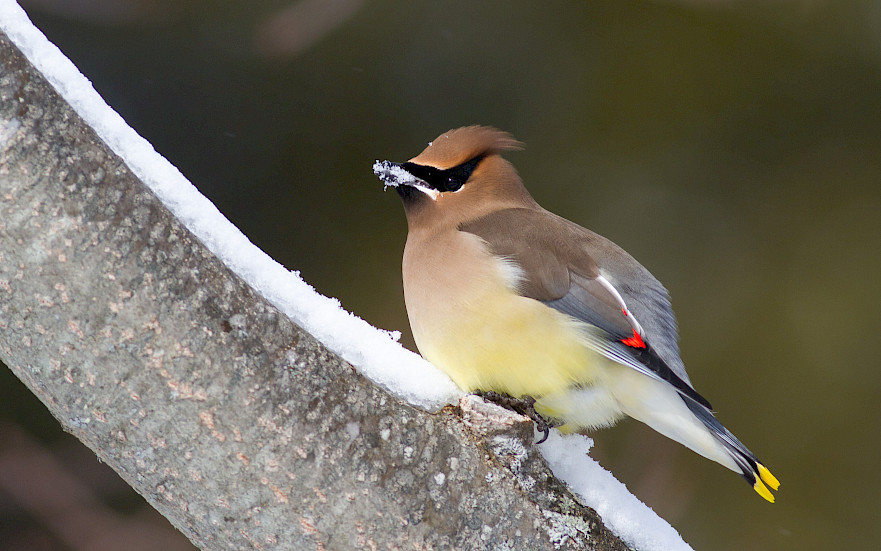
Cedar Waxwings have a brown and yellow belly, white undertail feathers, and lack white wing markings.
Photo: Fyn Kynd, licensed under CC BY 2.0.
By early March, the Bohemian Waxwings started migrating to their breeding grounds, arriving by April or early May. I read that Bohemian Waxwings don’t have strong site fidelity to breeding areas or territories, likely due to the ephemeral and patchy nature of the fruit they subsist on. This lack of territoriality may be why Bohemians don’t have a true song.
The International Union for Conservation of Nature estimates the global population of Bohemian Waxwings at >3,000,000 birds, with a conservation listing of “least concern” due to high numbers and huge breeding area. Of this global population, Partners in Flight estimates ~1,400,000 Bohemians in North America. What an honor and privilege to host ~0.4% of the continental population of Bohemian Waxwings in my backyard this winter! I hope they wander back next year.
For some absolutely gorgeous images of Bohemian Waxwings, check out Dutch photographer Roeselien Raimond’s website.