
Plants that evolved in Florida over millennia now face extinction and lack protection
Editor’s note: The following article by Andre A. Naranjo of Florida International University was originally published by The Conversation and is republished here under a Creative Commons license.

Modern scrub mints, delicate flowering plants that grow mostly in Florida, likely result from ancient hybridization, according to a recent study I published with colleagues.
Scrub mints are a clade – a group of organisms that share a common ancestor. They grow exclusively on the North American coastal plain. Many species in this clade are endangered and confined to unique habitats, such as sandhills and scrub.
Other well-known examples of clades include primates, orchids, daisies and insects.
Hybridization occurs when two species interbreed and produce new offspring with genes and traits from both species. Our study suggests that scrub mints hybridized during a geological period known as the Pleistocene, which lasted from about 11,700 to 2.58 million years ago.
One significant finding from our work is that a group of scrub mints called calamints that taxonomists classified as part of the genus Clinopodium as early as 1899 are actually genetically distinct from other plants in this genus.
These types of misclassifications create confusion around species’ identities, delaying conservation actions and leaving many rare plants without legal protections.
Our work suggests that calamints may consist of several separate species that need new scientific names, including the scarlet calamint, Georgia calamint and Ashe’s calamint—all of which currently lack endangered status.
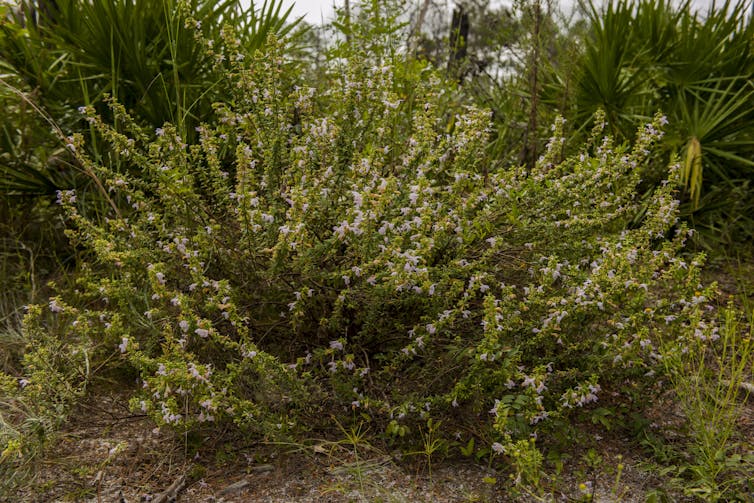
Additionally, we discovered that annual scrub mints in the genus Dicerandra originated from repeated hybridization events with their perennial relatives. This suggests that hybridization is a common mechanism of diversification in these rare plants.
We also found that the Titusville balm, currently classified as a recent hybrid, has actually been evolving for hundreds of thousands of years.
Reclassifying a plant takes time and effort, requiring genetic and morphological analysis followed by formal scientific description. However, this process would allow these plants to be recognized under conservation laws.
Why it matters
The potential extinction of one of Florida’s ancient plant species represents the loss of millions of years of evolution. These plants have adapted over millennia, and their disappearance would leave lasting gaps in the region’s ecological history.
The collapse of these species also threatens broader ecosystems, including wildlife such as scrub jays and insects such as bee flies that rely on them for food and shelter.
Of the 24 known scrub mint species, over half are listed as threatened or endangered.
However, plants that hybridized recently are not considered true species under the Endangered Species Act, meaning they often lack legal protection—even in habitats that are rapidly disappearing due to development.
How we did our work
We used genetic sequencing of 238 genes to map relationships among these species and compare DNA patterns across available datasets.
This allowed us to identify distinct lineages and clarify relationships that are difficult to determine from individual genes alone.

What still isn’t known
While the study clarified many relationships, questions remain about evolutionary connections within these plants.
Different genes can tell different evolutionary stories, leaving some relationships unresolved, especially among perennial species.
There may also be hidden diversity within calamints—plants that appear similar but are genetically distinct.
Researchers are still uncertain whether small populations could persist in microhabitats or be supported through conservation efforts.
About the author: Andre A. Naranjo is Botanical Curator at Florida International University.
This article is republished from The Conversation under a Creative Commons license. Read the original article.